
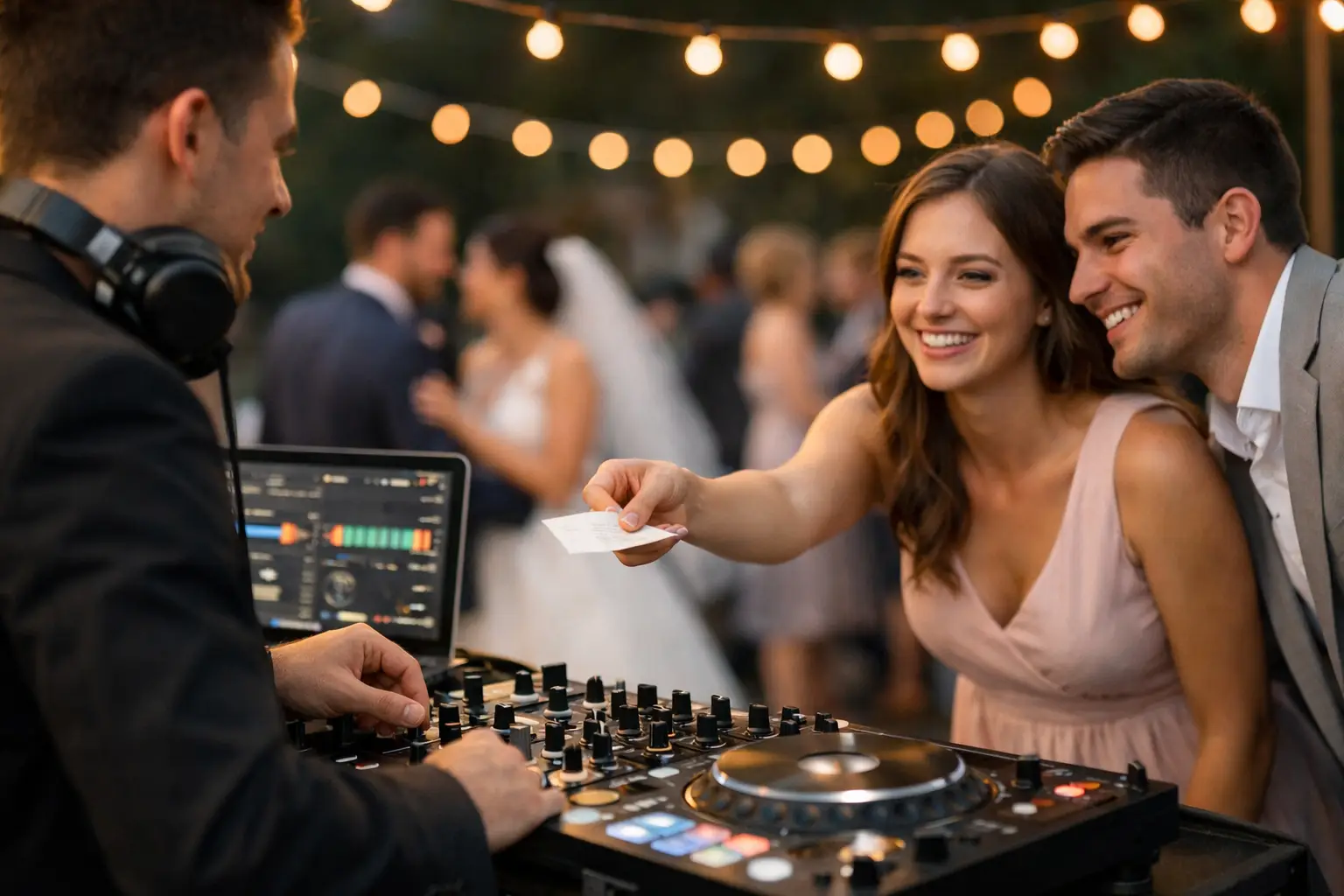
You have spent months choosing the right music for your wedding, then one guest wanders over to the DJ asking for a track that clears the dance floor in seconds. That is why so many couples ask, do wedding DJs take requests? The honest answer is yes, often they do, but the better answer is that it depends on how the DJ manages them.
A professional wedding DJ is not there to act as a jukebox. They are there to read the room, protect the atmosphere and keep the night moving. Requests can absolutely add to that, but only when they fit the crowd, the moment and the plan you agreed in advance.
Do wedding DJs take requests during the reception?
Most experienced wedding DJs will accept requests to some degree. It is part of the job to be flexible, respond to the crowd and make sure guests feel involved. Weddings are mixed-age events, and a good DJ knows there is value in playing a song that gets a particular group up on the floor.
That said, there is a big difference between welcoming a few sensible requests and allowing the playlist to be hijacked. If every guest gets full control, the evening can quickly lose shape. One table wants Motown, another wants current chart, one friend wants drum and bass, and an uncle asks for something from 1974 that nobody else knows. Without some control, it turns into a patchwork rather than a proper party.
This is why many DJs work to a simple rule. Requests are welcome if they suit the event, suit the couple and help the dance floor rather than empty it.
Why some requests work brilliantly
When handled properly, requests can improve the atmosphere. They make guests feel included and can help bring together different generations who may not all respond to the same style of music. A well-timed request can also rescue a quiet patch if the DJ knows it will connect with the right group at the right time.
There is also the personal side of it. Weddings are emotional events. Sometimes a request has meaning, perhaps a university anthem for the bride’s friends, a family favourite that fills the floor, or a song linked to a group memory. Those moments can be brilliant, and a capable DJ knows how to fit them into the night without losing momentum.
The key point is timing. A great DJ does not just play a request because someone asked loudly enough. They decide whether it belongs in that slot, whether it fits what has just been played and whether it keeps the room moving in the right direction.
When requests become a problem
The biggest issue with guest requests is not the idea itself. It is volume, timing and suitability. Some tracks are excellent songs but poor wedding songs. Others might suit a niche group while leaving everyone else standing around. Then there are requests that clash with the tone of the evening altogether.
You may also have songs you simply do not want played. Many couples have a shortlist of banned tracks, whether that is novelty songs, overplayed wedding clichés or music tied to bad memories. A professional DJ should always take the couple’s preferences above guest requests.
Another practical issue is availability. Most DJs carry extensive music libraries, but no DJ can promise every song ever released. If somebody asks for an obscure remix, a live version or something highly specific, it may not be possible. That is normal, and it is one reason planning matters.
The couple should always have the final say
At a wedding, the most important requests are the couple’s. That means your first dance, any must-play tracks and any do-not-play songs need to be clear before the event. Once that is in place, the DJ can handle guest requests within those boundaries.
This is usually the best setup because it gives structure without making the evening feel rigid. Guests can still make suggestions, but the DJ has a clear brief to protect the style of the night.
How professional wedding DJs usually handle requests
The strongest DJs tend to use one of three approaches. Some welcome requests from guests but filter them carefully. Some only take requests if they have been approved by the couple in advance. Others ask the couple whether they want open requests, limited requests or none at all.
None of these approaches is wrong. It depends on the type of wedding you are planning. A relaxed mixed-age reception may suit open requests with sensible DJ control. A more curated evening, where the couple have a strong music taste, may work better with limited requests.
This is one of the reasons it helps to book an experienced company rather than someone who simply turns up with speakers and a playlist. A proper wedding DJ understands crowd flow, announcements, venue timing, sound levels and music transitions. They know when to take a request seriously, when to hold it for later and when to politely decline it.
Should you let guests request songs at your wedding?
For most couples, the answer is yes, with some limits. Completely blocking requests can work if you want full control, but many weddings benefit from allowing a few. It helps the evening feel lively and responsive rather than fixed.
The better question is how much freedom you want guests to have. If you are happy for the DJ to take suggestions but trust them to decide what works, say that. If you only want requests from close family or the bridal party, say that. If there are genres you want avoided, make that clear too.
A good DJ will not be put off by guidance. In fact, they usually prefer it. Clear direction makes it easier to deliver the kind of night you actually want.
Set the rules before the day
The simplest way to avoid awkwardness is to decide your approach in advance. Tell your DJ whether you want open requests, restricted requests or no requests at all. Give them your must-play list and your banned list. If there are certain moments where you do not want interruptions, such as your first dance set or a planned party section, mention that too.
This short conversation can prevent a lot of confusion on the night. It also means the DJ can deal with guests confidently, because they are working from your instructions rather than making it up as they go.
What to ask your DJ before booking
If music matters to you, ask directly how they handle requests. Do they take them from anyone? Do they check with the couple first? Will they refuse songs that do not fit the room? Can they work from a must-play and do-not-play list?
These questions tell you a lot about how the DJ works. You are not just hiring somebody to press play. You are hiring somebody to manage the flow of one of the biggest parts of your reception.
It is also worth checking the wider professional side. Experienced wedding suppliers should be reliable with communication, clear on timings and properly prepared for venues. Things like PAT-tested equipment and public liability insurance matter, especially when venues ask for paperwork. Couples often choose a full-service supplier for exactly this reason. It keeps planning simpler when your entertainment and styling can be organised under one roof, rather than chasing several companies separately.
The best approach for most weddings
In practice, the best option is usually controlled flexibility. Let the DJ take requests, but only if they fit your brief and the dance floor. That gives guests a voice without handing over the whole evening. It also allows your DJ to do the job you are paying them for, which is to build the atmosphere, not react blindly to every suggestion.
At Mobile Disco Hire Birmingham, this is how many wedding bookings are handled. Couples give their key songs and any banned tracks, then the DJ reads the room and manages requests properly on the night. It is a straightforward approach that keeps the party personal without letting it drift off course.
If you are deciding whether to allow requests, do not think of it as a yes or no issue. Think of it as part of the plan. With the right DJ, requests can add energy, personality and a few memorable moments. With no plan at all, they can do the opposite. The trick is not just whether requests are allowed, but who is in control when they happen.
