
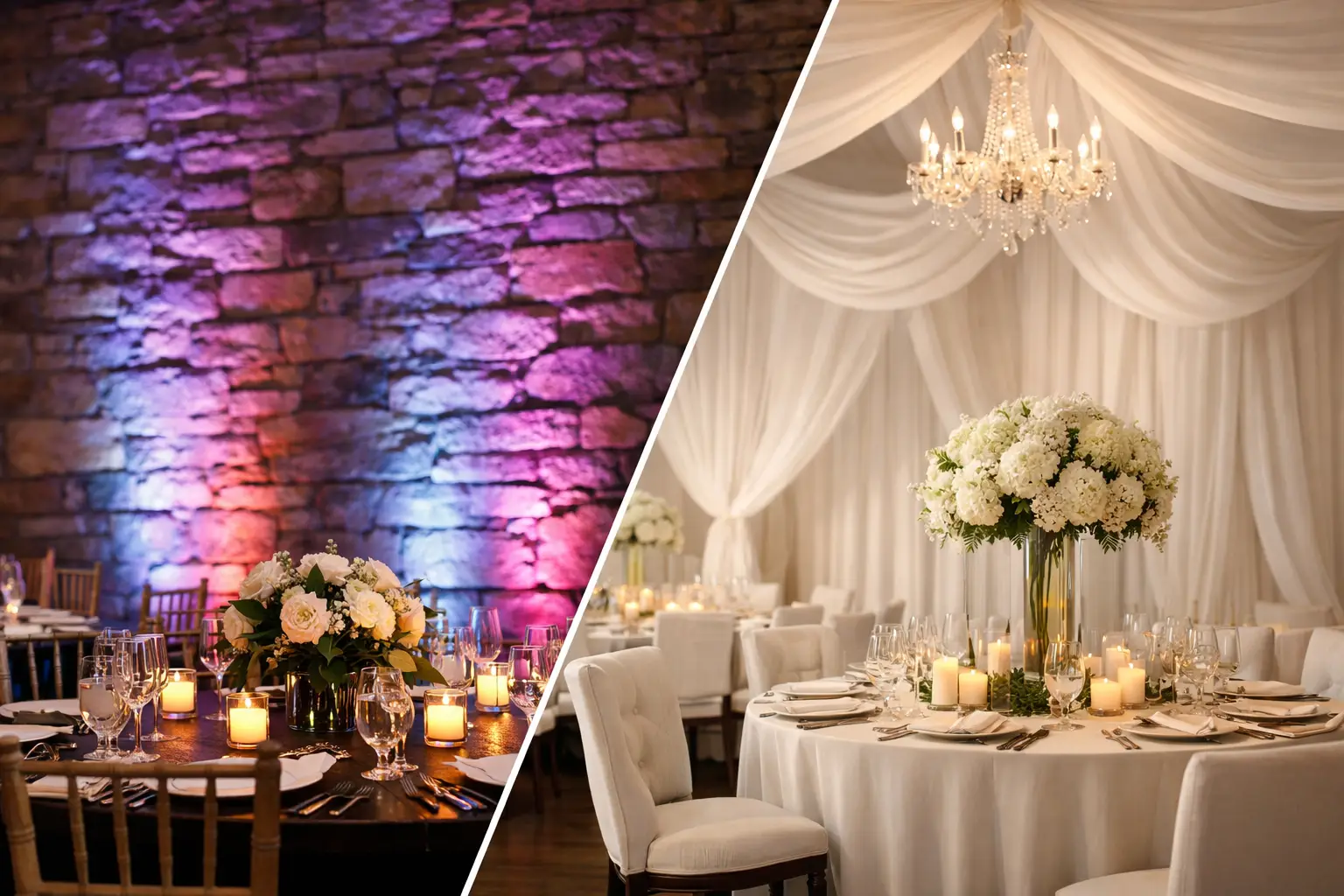
Some venues look great in the brochure, then feel flat the moment you walk in. That is usually where the decision around uplighting vs venue draping starts. Both can transform a room, but they do very different jobs, and choosing the right one can save money, avoid over-dressing the space, and give your event a much more polished finish.
For weddings, birthday parties and corporate functions, the right styling choice depends on the venue itself, the time of day, the size of the room and the overall look you want. If you are trying to decide between the two, it helps to think less about trends and more about what needs improving in the space.
Uplighting vs venue draping: the real difference
Uplighting uses LED lighting units placed around the room to project colour upwards onto walls, columns, alcoves or features. It changes the mood of the venue quickly and can make a plain room feel warmer, more elegant or more energetic depending on the colour and brightness used.
Venue draping is more structural. It uses fabric to cover or frame parts of the room, whether that means full wall drapes, backdrop draping, ceiling treatments or softening awkward areas. Draping changes the shape and finish of a venue, not just the colour of it.
That distinction matters. If your venue already looks smart but feels a bit bland, uplighting may be all you need. If the venue has unattractive walls, visible storage areas, dated curtains or sections you would rather hide, draping usually has a stronger effect.
When uplighting is the better choice
Uplighting works particularly well in venues that already have decent architecture or clean wall space. Hotels, function suites and barn venues often benefit from colour washing because the room does not need hiding – it just needs atmosphere.
For evening receptions, uplighting is one of the simplest ways to change the energy in the room. Soft amber, warm white or blush tones can make a wedding breakfast room feel more refined. Stronger colours can make a party or corporate event feel branded and lively once the music starts.
It is also a practical option if you want impact without filling the room with extra fabric and framework. Setup is usually straightforward, and modern LED uplighting is flexible enough to match colour schemes closely. That makes it useful for couples who want their décor tied together, or for corporate organisers who need lighting to reflect brand colours.
Another advantage is that uplighting can highlight features you actually want guests to notice. If your venue has nice stonework, pillars, a cake table, a top table backdrop or an architectural focal point, lighting can draw attention to it rather than cover it up.
The limits of uplighting
Lighting cannot disguise everything. If the venue has tired décor, patchy wall finishes or areas that look too functional, coloured light may actually make those flaws more noticeable. It also has less effect in bright daytime conditions, especially in rooms with lots of natural light.
That does not mean it is ineffective during the day, but expectations should be realistic. In full daylight, uplighting tends to add a subtle wash rather than a dramatic transformation.
When venue draping is the better choice
Venue draping is often the smarter choice when the room needs correcting, not just enhancing. If there are unsightly walls, mirrors in the wrong place, doors that interrupt the layout, or sections of the room that feel cold and empty, draping gives you more control.
It can also make a large room feel more finished. Big venues sometimes swallow a smaller guest count and feel sparse. Draping can help define the event area, soften hard edges and create a more intimate setting without changing venue.
For weddings, draping is especially useful behind top tables, cake displays and sweetheart tables where photographs matter. A clean draped backdrop with coordinated lighting can instantly make the room feel more premium. For parties and corporate events, draping can tidy the visual background and stop the venue itself from competing with your theme.
There is also a softness to fabric that lighting alone cannot create. Draping adds texture, depth and a styled look even before the lights dim. If you want a room to feel dressed rather than simply illuminated, draping usually gets you closer.
The limits of draping
Draping is not always the best use of budget. In a naturally attractive venue, full draping can be unnecessary and may even hide features you have paid for. It also tends to involve more materials, more labour and more installation time than uplighting.
Some venues have restrictions too. Ceiling access, wall fixing rules, setup windows and fire safety policies all need checking in advance. This is where using an experienced, insured supplier matters, because not every styling idea suits every room.
Which option gives better value?
Value is not just about the cheapest line on a quote. It is about what makes the biggest difference to your venue.
If the room is basically sound and only needs atmosphere, uplighting often delivers the strongest return. It can shift the whole mood of a venue at a relatively sensible cost, especially when paired with other existing styling elements such as centrepieces, chair covers or an LED dance floor.
If the room has obvious visual problems, draping may save you from spending money elsewhere trying to distract from them. In that case, the higher cost can be worth it because it solves a bigger problem.
For many events, the best value is not uplighting or draping on their own. It is a combination of selective draping and coordinated lighting. A backdrop, key wall drape or focal drape with uplighters can produce a much stronger finish than either feature used in isolation.
Uplighting vs venue draping for weddings
Weddings usually need both atmosphere and a good photographic finish, so the choice comes down to what the venue lacks. If your room is neutral, tidy and reasonably modern, uplighting can be enough to bring in romance and colour. Warm white and soft pastel tones tend to work well for the wedding breakfast, with richer tones later for the evening reception.
If the venue has dated panels, dark curtains or blank areas behind the top table, draping may be the better priority. Guests might not analyse why a room feels more elegant, but they do notice when the setup looks complete.
There is also the timing to consider. Daytime weddings in bright function rooms often get less dramatic impact from uplighting until later in the day. Draping, by contrast, looks effective from the moment guests enter.
Uplighting vs venue draping for parties and corporate events
Birthday parties and anniversary events often lean more towards atmosphere, so uplighting can be a strong standalone option. It works well when the goal is to make the room feel lively, coordinated and ready for the evening. It also pairs naturally with DJ lighting and dance floor setups.
Corporate events can go either way. If the venue already feels professional, uplighting may be enough to add brand colours and sharpen the look of the room. If the event space needs tidying for presentations, awards or staged photography, draping often brings a cleaner finish.
For Christmas parties, awards nights and launches, the most successful setups usually combine visual control with lighting atmosphere. A good room should look right both when guests arrive and later when the event moves into full swing.
The practical questions to ask before choosing
Before booking either option, look honestly at the venue in ordinary light. Ask what actually needs changing. Is it the mood, the colour, the brightness and energy of the room? Or is it the venue itself that needs softening, hiding or framing?
You should also consider guest numbers, ceiling height, access times and your wider styling package. If you are already booking LED backdrops, love letters, chair covers or a dance floor, the best result may come from making those elements work together rather than choosing one feature in isolation.
This is where booking with one supplier can make planning easier. Coordinating entertainment, lighting and venue styling through one experienced team reduces the usual back-and-forth between separate companies and helps the room feel consistent rather than pieced together. For clients who want a straightforward process, Mobile Disco Hire Birmingham can provide both event styling and entertainment products under one roof, with PAT-tested equipment, experienced staff and venue-ready cover already in place.
So which should you choose?
Choose uplighting if your venue already looks good and you want to change the mood, add colour and lift the space for the evening. Choose venue draping if the room needs improvement at a structural level or you want a softer, more dressed finish throughout the day.
If the budget allows, combining the two usually gives the most complete result. Draping shapes the room, and uplighting brings it to life. The best choice is rarely about what is more fashionable – it is about what your venue needs most.
A well-planned event does not need every extra available. It just needs the right ones, used in the right place, so the room looks considered from the moment guests walk in.
